
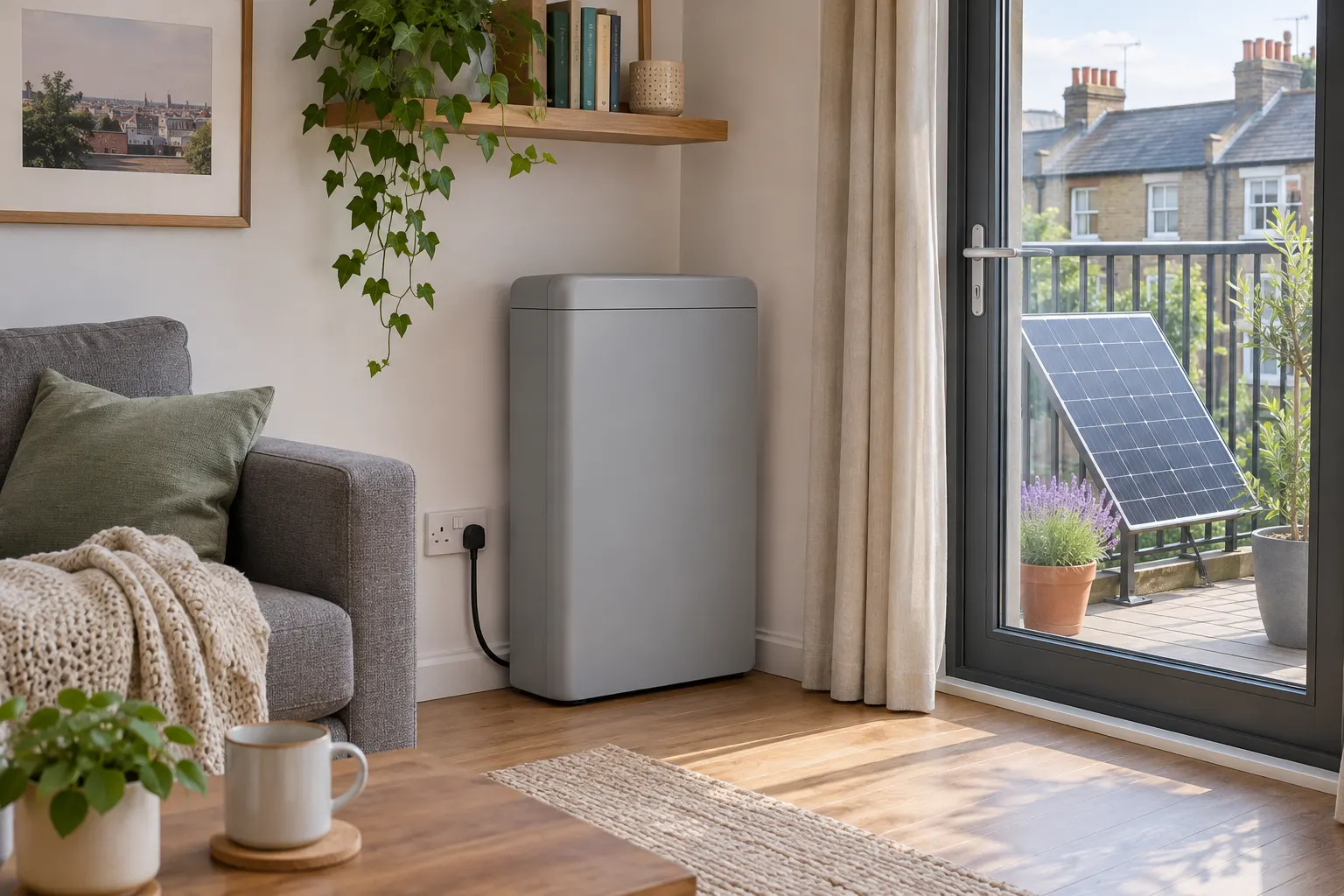
A plug in solar battery is not allowed in the UK: the rules that legalised plug-in solar on 27 August 2026 cover devices without batteries only, and a plug-in device with a battery is still not permitted. Not allowed SI 2026/848 reg. 2(3)(e) You can still use plug-in solar without storage, or have a battery fitted by an electrician as a separate job. This guide explains why, what the government said in July 2026, and your options today.
Why Batteries Are Excluded
Plug-in solar and a home battery sound like one product. The law treats them as two, and the second was left out on purpose. If you landed here after seeing a kit advertised “with battery”, this section explains why that is not the same thing.
What the Law Says
SI 2026/848 defines a plug-in solar device as a solar generator with a rated AC output of no more than 800 W, connected through an ordinary plug and socket, in parallel with the grid, and without batteries (apart from control or auxiliary functions). SI 2026/848 reg. 2(3) A device that fails that definition does not get the permission to be sold, supplied or used as plug-in solar. A device with a battery fails it. SI 2026/848 reg. 2(3)(e); Ofgem decision DCRP/MP/26/02
The same definition sits behind everything else in the scheme: the 800 W AC cap, the three-pin plug, the registration on myplugin.solar before you use the device. Electricity North West, plug-in solar, 2026 The whole framework was written around a small generator that can only produce power when the sun is shining. Our main plug-in solar guide covers those rules in full, and the legal guide lists the sources and the points where official documents disagree.
What the Government Said in July 2026
DESNZ published its Government Response in July 2026, alongside the interim product specification. It is explicit that the proposals “relate only to plug-in solar devices without batteries” and “do not extend to plug-in batteries or other forms of plug-in microgeneration”. DESNZ Government Response, July 2026
It also acknowledges the demand. The government “recognises stakeholder interest in battery-integrated products” but says they “raise additional technical and regulatory issues that have not been assessed through this work”. DESNZ Government Response, July 2026
Read that carefully. It does not say batteries are unsafe, and it does not promise they will be allowed. It says the question has not been assessed. That is why the exclusion is firm today and why nobody can honestly tell you a date for a change.
Kits Sold “With a Battery” in the UK
Search for a plug in solar battery kit and you will find products described as balcony or plug-and-play systems with storage. Some sellers use the words “plug-in” loosely. The test is the legal definition above, not the marketing.
Some of these products appear in third-party listings with claims about G98 or ENA compliance. We have not confirmed any of those specifications on the brands’ own UK pages, so we do not name them here. Check the brand’s UK page, and the questions below, before you rely on any of it.
What matters is how to read such a listing:
- Does the page call it a plug-in solar device under SI 2026/848? A product that needs an electrician is, by its nature, not the plug-in-and-go device the regulations describe.
- Is the battery inside the same unit as the inverter? If so, it falls outside the definition of a plug-in solar device.
- What does the output figure include? An AC figure above 800 W is outside the plug-in cap, whatever the box says.
- Does the seller state compliance with the interim product specification? If the listing is silent, ask.
A battery system sold with panels is a legitimate product. It is simply a different category from the 800 W plug-in kit, with a different installation route, and it should not be bought on the assumption that it is covered by the plug-in rules. For the plug-in kits that do fit the rules, see our kit comparison.
Your Options Today
Three routes exist if you want solar and are thinking about storage. Only the first is plug-in solar.
Plug-In Solar Without a Battery
This is the product the law now allows. It works best if you use power in the daytime: a fridge, router, standby loads, someone working from home. Whatever the panels produce is used by the house first. When the kit makes more than the house uses, the surplus flows out to the grid, and there is no documented route to be paid for it today. That is the real cost of having no battery, and it is better to know it before you buy than after.
DESNZ said on 26 August 2026 that households could save up to £110 a year. Read that as a ceiling, not an average. DESNZ news, 26 Aug 2026 Your own figure depends on shade, orientation and how much you use in daylight. Our savings calculator works from your inputs rather than a headline number.
A Battery Installed by an Electrician
If evening use is what you want to cover, a battery fitted as a separate installation by a qualified electrician sits outside the plug-in scheme. The installer handles the wiring, the safety isolation and the grid connection process. This is a different job from plugging in a kit, with its own rules and its own cost, and it is not what this guide covers. We do not quote prices for it here. If you go this way, ask the electrician which connection process applies to your property and get that in writing.
Separate Plug-In Batteries
Some batteries are sold as standalone units that charge from a normal socket and power things plugged into them. They are not solar generators and do not feed the grid, so on the face of it they sit outside the plug-in solar regulations. We could not confirm their legal status, and the Government Response says plug-in batteries were not part of the work. DESNZ Government Response, July 2026
Two cautions apply. First, charging such a battery from a plug-in solar kit would turn the combination into a solar-and-battery system, which is the thing the definition excludes. We could not confirm how the rules treat that arrangement, so do not assume it is allowed. Second, a battery charged from the mains is a different use case, and its safety and insurance position are for you to check with the maker and your insurer.
Will the Rules Change?
We cannot tell you, and neither can anyone selling you a battery kit. The facts as published:
- The July 2026 Government Response limits the new permission to devices without batteries. DESNZ Government Response, July 2026
- It says battery-integrated products raise issues that have not been assessed.
- It says the government will “continue to monitor implementation” and work with stakeholders, enforcement bodies and standards organisations as the market develops.
No consultation on batteries, no timetable and no draft rule appears in the documents we read. We have not found any official statement that a change is planned. If that changes, this page will change with it, and the date at the top will move.
Until then the practical advice is simple. Buy plug-in solar for what it is, a way to cover daytime use at low cost. If you want storage, treat it as a separate project with an electrician. And be wary of any listing that blurs the two.
Sources
Each one opened and checked on 10 November 2026.
- SI 2026/848, the Plugs and Sockets etc. (Safety) and ESQCR (Amendment) Regulations 2026
- Electricity North West, plug-in solar (register on myplugin.solar)
- Ofgem, decision on DCRP/MP/26/02 (G98 for plug-in microgeneration)
- DESNZ, Plug-in solar: Regulatory amendment and interim product specification, Government Response (July 2026)
- DESNZ, Plug-in Solar Device Interim Product Specification v2 (16 July 2026)
- DESNZ news, 26 August 2026: plug-in solar panels come to market
Questions people ask
How many batteries do I need for 400 watts of solar?
With a legal UK plug-in kit, none: a plug-in solar device cannot contain a battery. A 400 W panel feeds your home directly while the sun shines. If you want storage, that is a separate, electrician-installed system, and the number of batteries depends on your evening use, not on the panel.
Do batteries stop charging when solar gets full?
Yes. A battery that reaches full charge stops accepting power, and a hybrid system then sends the surplus to the house or the grid, or the panels throttle back. This applies to installed systems with a battery. A plug-in solar kit has no battery, so it simply powers what is running.
Is it better to have more solar panels or more batteries?
It depends on when you use power. More panels help if you use a lot in daylight. More battery helps if your use is mostly evening. For a UK plug-in kit the question does not arise: output is capped at 800 W AC and the unit cannot hold a battery.
Can I add a battery to plug-in solar later?
Not to the plug-in unit itself: a plug-in device with a battery is still not permitted. A battery fitted by an electrician as a separate installation is a different matter and outside these rules. We could not confirm the status of separate plug-in batteries.