
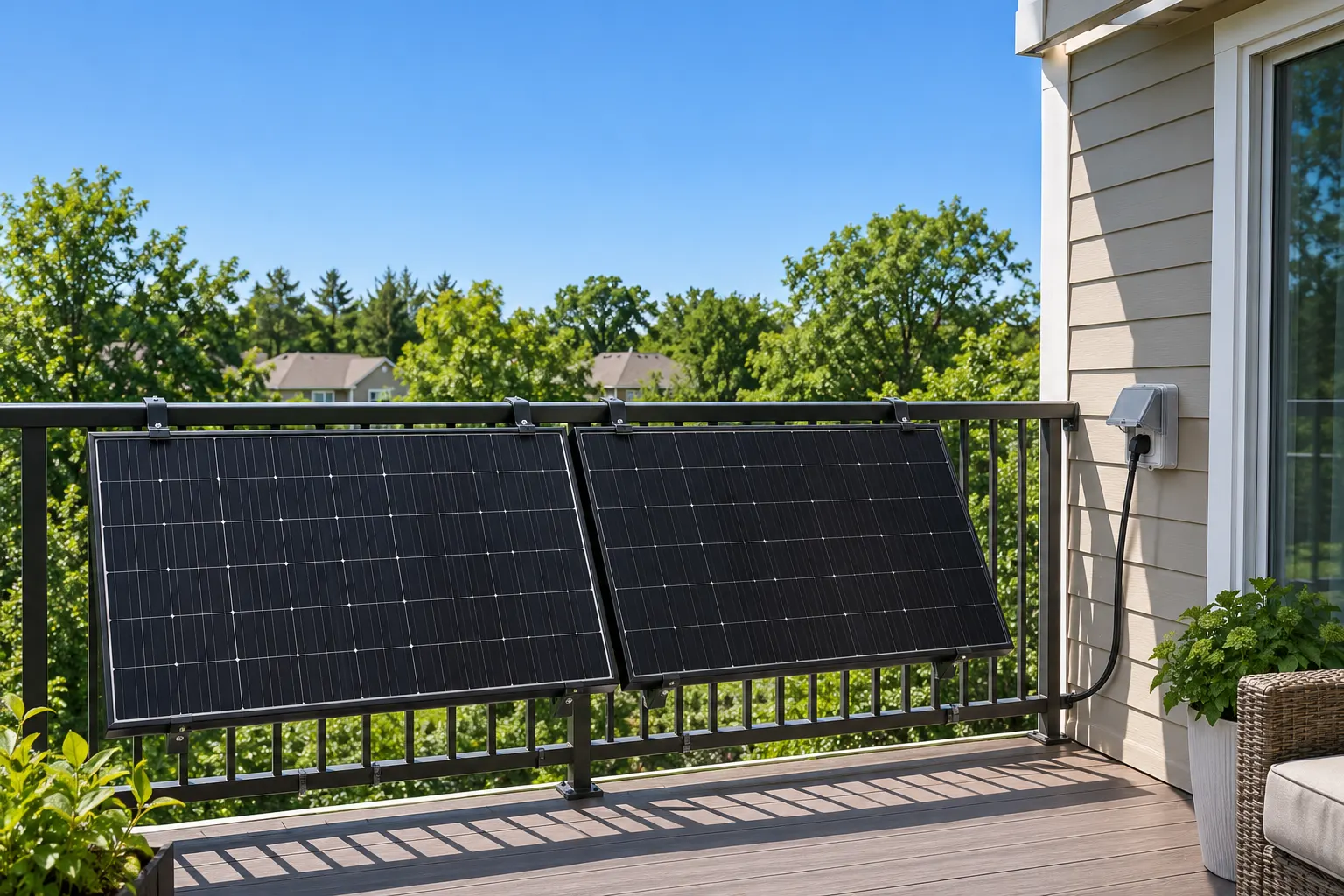
Plug in solar is a small solar kit you connect to a standard wall outlet: one or two panels, a microinverter and a cord. No roof work, no installer, no interconnection application in the states that have passed a law. As of November 9, 2026, ten states have a signed plug-in solar law: Utah, Maine, Virginia, Colorado, Maryland, New Hampshire, Connecticut, Vermont, New Jersey and California. The typical cap is 1,200 W of AC output, and Colorado allows up to 1,920 W. Colorado HB26-1007, 2026 This guide shows each rule with its source and the date we checked it.
- Law in force
- Signed, starts later
- No state law (not a ban)
- Bill passed, not law
Tap a state to see its rule.
What Is Plug-In Solar?
Think of it as the smallest solar system you can own. You mount the panels on a balcony rail, a ground frame, a fence or a wall, run the cord to an outdoor or indoor outlet and plug in. The kit feeds electricity into your home’s wiring, and anything already running in the house uses it first. People also call it balcony solar or plug and play solar, and the idea is the same.
Panels, Microinverter, 120 V Outlet
- 1
Panels
Up to 2,000 W of DC
- 2
Microinverter
Converts DC to AC
- 3
Standard plug
Into a dedicated outlet
- 4
Your home
Appliances use the power first
A plug in solar system has three parts. The panels turn light into direct current. The microinverter converts that into the alternating current your home uses, and it stops producing when the grid goes down so it cannot feed power into a dead line. The cord goes into a standard 120 V outlet. Utah HB 340, 2026
The state laws add conditions around that. Utah requires a 120 V outlet, the latest National Electrical Code, certification by UL or an equivalent nationally recognized testing laboratory (NRTL), and anti-islanding protection. Utah HB 340, 2026 Most of the newer laws follow the same pattern.
Why Watts Are Capped at 1,200 W
Almost every signed law uses 1,200 W of AC output as the ceiling. The figure is about what the microinverter can put into your home, not how many watts of panels you bolt on. Utah, Maryland, New Hampshire, Connecticut, Vermont, New Jersey and California all state 1,200 W. Maryland HB 1532 fiscal note, 2026 Connecticut PA 26-127, 2026 Virginia sets 1,200 W per customer, or per unit in a multifamily building. Va. Code § 56-596.8, 2026 Colorado is the outlier at 1,920 W, with one system per home and one per outlet. Colorado HB26-1007, 2026
Maine is more detailed. Up to 420 W needs nothing further. Between 420 W and 1,200 W it requires a licensed electrician, a dedicated circuit with a single outlet, and notice to the utility within 30 days. Maine LD 1730, P.L. 2026 c. 644
When a kit lists panels above the cap, compare the inverter rating first. It is the inverter that sets the number the law cares about.
Is Plug-In Solar Legal in Your State?
This is the summary. The state-by-state detail, with sources, lives on our full legal guide and the state pages. There is no federal ban and no federal rule of its own, so what governs a kit is your state law, if there is one, and your utility’s interconnection rules. NFPA 70 proposed TIA 1951
In Force Now: Utah, Colorado, Connecticut, Vermont, Maryland, Maine
Utah Utah’s law is the oldest. HB 340 was signed on March 25, 2025 and took effect on May 7, 2025. The utility cannot require approval, a fee or extra equipment, and there is no notification step. Utah HB 340, 2026
Colorado HB26-1007 took effect on August 12, 2026. Kits must be listed by an NRTL and have anti-islanding, and the utility may ask for notice of the system’s presence and size. Colorado HB26-1007, 2026
Connecticut Public Act 26-127 took effect on October 1, 2026. It calls for a 120 V outlet, UL or NRTL listing, UL 1741 and anti-islanding, and it warns that exported power may be billed as consumption if you have no net metering. Connecticut PA 26-127, 2026
Vermont Act 149 took effect on July 1, 2026. It requires UL 3700 or an NRTL equivalent, a smart meter, and says exported power is not paid. Vermont Act 149, 2026
Maryland HB 1532 was signed on May 12, 2026. The revised fiscal note gives July 1, 2026 as the effective date, but one tracker says it took effect on signing, so treat the exact date with care. The law requires you to notify the utility before you install. Maryland HB 1532 fiscal note, 2026
Maine Maine’s governor signed LD 1730 on April 6, 2026. We could not confirm the effective date from the law’s text: it has no emergency clause, which would normally put it 90 days after the session ends, and one trade outlet reports July 2026. Maine LD 1730, P.L. 2026 c. 644
Signed, Not in Force Yet: Virginia, New Hampshire, California, New Jersey
Virginia The law takes effect on January 1, 2027. You must notify the utility before you install, and the utility has 15 days to respond or the notice is treated as met. Va. Code § 56-596.8, 2026
New Hampshire SB 540 was signed on July 2, 2026 and takes effect on January 1, 2027, with one system per metered customer. A tracker gave a July 2026 date, but the chaptered text says 2027, and the text wins. New Hampshire SB 540, ch. 262, 2026
California SB 868 was chaptered on September 30, 2026 and applies from January 1, 2027, with a 1,200 W cap per dwelling. The utility may ask for a simple online registration, but not approval. Certain exemptions in the law end on January 1, 2030. California SB 868, 2026
New Jersey The Garden State Balcony Solar Act was signed on September 1, 2026 and takes effect six months after enactment, on March 1, 2027. It exempts kits from interconnection and net metering and bars utility fees and approvals. NJ Governor, 1 Sep 2026
No State Law: What to Do
No law yetIn a state without a law, we say it plainly: no state law; your utility’s interconnection process applies. We do not call it illegal. Every signed law exempts plug-in kits from interconnection requirements, which suggests those requirements apply where no law exists, but that is our inference and we could not check it utility by utility.
New York is the case people ask about. The SUNNY Act passed both chambers on May 28, 2026, but the Senate record shows no delivery to the Governor, no signature and no veto, so it is not law. It could still be delivered before the end of the year, and we will update this page if it is. NY Senate S8512C, 2026 Massachusetts has a bill that press reports say passed the House, but we could not confirm it on the legislature’s site.
If your state has no law, contact your utility before you plug in and ask what it requires for a small grid-connected generator.
Plug-In Solar Safety Standards
Two things get confused here: product standards and the electrical code.
UL 3700 Is Not a Finished Standard
UL 3700 is an Outline of Investigation, not an ANSI standard. Maine’s and Vermont’s laws cite it, along with comparable NRTL standards, and New Jersey’s law refers to UL 3700 or an equivalent. Maine LD 1730, P.L. 2026 c. 644 Vermont Act 149, 2026 In practice, look for a listing from a recognized lab, and read the state law you fall under to see which listing it names.
The National Electrical Code Has No Category for It
The National Electrical Code in its 2020, 2023 and 2026 editions has no definition of a plug-in photovoltaic system. A proposed tentative interim amendment (TIA 1951) says local inspectors have no recognized category to cite on permit documents. Proposals like it are not adopted, and the proponent is a manufacturer with an interest, so read it as a signal, not a ruling. NFPA 70 proposed TIA 1951
What Every Kit Should Have
- A 120 V outlet connection and a cord rated for it.
- Certification by UL or a comparable NRTL, as your state requires.
- Anti-islanding, so the inverter shuts down when the grid is down.
- A mount that holds in wind and is secure but not permanent.
Plug-In Solar Cost and Savings
Kit Prices
Prices move quickly in a new market, so we do not print them in the text. Our comparison table reads them from each brand’s own store and shows the date we read them.
| Kit | AC output | Certification | Price | Store |
|---|---|---|---|---|
| US Solar Supplier1180W Plug-In Solar Kit (APsystems EZ1 + 2 x HanerSun 590 W) | 900 WFits a 1,200 W cap | Not stated on the kit page | $899read Nov 9, 2026 | US store |
| US Solar Supplier880W Plug-In Solar Kit (Hoymiles + 2 x HanerSun 440 W) | Not statedCheck the AC rating | Not stated on the kit page | $629read Nov 9, 2026 | US store |
| PluggedSolarPlug-in & Balcony Solar System, 4 x 200 W | Not statedCheck the AC rating | UL 3700 and UL 1741 (seller's statement) | $1,595read Nov 9, 2026 | PluggedSolar store |
| CraftStrom800 Watt Plug&Play Solar | 700 WFits a 1,200 W cap | ETL to UL 1741 and IEEE 1547 (seller's statement) | $1,846.65read Nov 9, 2026 | CraftStrom store |
| EcoFlowSTREAM Microinverter (inverter only) | Not statedCheck the AC rating | UL 1741 (seller's statement) | $369read Nov 9, 2026 | EcoFlow store |
Prices read on each brand's own store on Nov 9, 2026; they change often. Certifications are as stated by the seller; we have not seen the certificates. We compare published specifications; we have not tested these kits.
See best plug-in solar kits for the full comparison.
Savings
We found no national savings figure from an official source, so this page does not give one. What decides your number is how much sun reaches the panels, how much of your daytime use is steady (a fridge, a router, standby loads) and your rate per kilowatt-hour. A shaded spot in an empty home will return little; a sunny balcony above a busy household returns more. The calculator takes those inputs instead of guessing.
Plug-in solar savings calculator
Your estimate per year
-
- Panels produce
- -
- You use at home
- -
- Inverter limit
- -
Email me this result
Data and assumptions
- Sun: yearly output per kW of south-facing panels, PVGIS 5.3 (NSRDB), European Commission JRC, 14% system losses, read Nov 9, 2026.
- Price: EIA Electric Power Monthly, Table 5.6.A, residential, August 2026 (a single summer month). Overwrite it with the rate on your bill.
- Inverter limit: the cap in your state's law; where there is no law we use 1,200 W, the cap most state laws set. Panel power above 1.3 times the limit (1.6 times for upright panels, which rarely reach full power) is counted as lost.
- Shade cuts output by 20% (partial) or 45% (heavy). Your share used at home is our assumption: 45%, 60% or 75% by daytime use. Power you do not use goes to the grid unpaid.
- An estimate, not a quote. It cannot see your roofline, trees or appliances.
No Net Metering
Several laws state that plug-in kits sit outside net metering. Utah’s law keeps them out of it, Maine’s law says no net metering applies, and Vermont’s says exported power is not paid. Utah HB 340, 2026 Vermont Act 149, 2026 Plan on using what you make, because the surplus earns nothing. That is why a kit suits steady daytime loads better than a mostly empty home.
Plug-In Solar for Renters and Apartments
Most people ask this question and most guides skip it. The laws differ a lot, so read the line for your state.
What the Laws Say About Landlords
- New Jersey: the Governor’s release says landlords, HOAs and similar bodies cannot broadly ban kits, and municipalities cannot ban them or require a permit. A landlord cannot prohibit a kit if the tenant pays for the electricity, beyond reasonable size and placement limits, and the tenant gives the landlord or HOA 14 days’ written notice with proof of compliance and the location. NJ Governor, 1 Sep 2026
- Vermont: a tenant gives the landlord 10 days’ notice. The landlord may set reasonable limits, and if the landlord does not answer in 10 days the tenant may install. Without approval, no electrical work. Vermont Act 149, 2026
- Colorado: from January 1, 2027, a ban that is unreasonable is void, including covenants. In a common interest community you can use a balcony or patio you have exclusive use of, and the owner can ask for notice and reasonable limits on fire risk, overload and placement. Colorado HB26-1007, 2026
- Maine: you must not compromise the structure of something you do not own, and you restore it when you remove the kit. There is no express right against a landlord. Maine LD 1730, P.L. 2026 c. 644
- Virginia: the law does not apply to rental units that split utility bills under a RUBS system. Va. Code § 56-596.8, 2026
- Utah, Maryland, New Hampshire, Connecticut, California: no landlord or HOA rule in the text, so your lease and your association’s rules decide.
In states with no law, the same applies: lease and association rules. We could not check general solar access laws state by state.
Balconies, HOAs and Lease Rules
Even where the law helps, a written request protects you. Describe the kit, say how it mounts, offer to remove it when you leave, and keep the reply. Our renters pack puts the letters, the checklist and the state rules in one place and updates them as laws take effect.
How to Choose a Plug-In Solar Kit
Four checks cover most of it:
- AC output at or under your state’s cap. Usually 1,200 W; 1,920 W in Colorado. Check the inverter, not the panels.
- A recognized listing. UL 3700 where your state names it, or an NRTL listing as the law requires.
- Anti-islanding. The inverter must stop when the grid is down.
- A 120 V plug that fits a standard outlet. No adapters, no extension cords.
| Kit | AC output | Certification | Price | Store |
|---|---|---|---|---|
| US Solar Supplier1180W Plug-In Solar Kit (APsystems EZ1 + 2 x HanerSun 590 W) | 900 WFits a 1,200 W cap | Not stated on the kit page | $899read Nov 9, 2026 | US store |
| US Solar Supplier880W Plug-In Solar Kit (Hoymiles + 2 x HanerSun 440 W) | Not statedCheck the AC rating | Not stated on the kit page | $629read Nov 9, 2026 | US store |
| PluggedSolarPlug-in & Balcony Solar System, 4 x 200 W | Not statedCheck the AC rating | UL 3700 and UL 1741 (seller's statement) | $1,595read Nov 9, 2026 | PluggedSolar store |
Prices read on each brand's own store on Nov 9, 2026; they change often. Certifications are as stated by the seller; we have not seen the certificates. We compare published specifications; we have not tested these kits.
The kit comparison checks each kit against these four points and shows the date we read each brand’s page.
Downsides of Plug-In Solar
Plug-in solar is useful, but it is not a replacement for a roof system. These are the limits to know before you buy:
- The cap. A bigger array does not push more into your home than the law allows.
- No payment for surplus. Net metering does not apply and exports earn nothing.
- Shade and orientation. A kit in the shade of a wall or tree makes little.
- Patchy law. Ten states have a law. Elsewhere your utility’s process applies.
- Dates still moving. Several laws take effect in 2027, and Maine’s date is unconfirmed.
- Permission when renting. Only a few states protect tenants, and most leave it to the lease.
- An unfinished standard. UL 3700 is an outline, and the National Electrical Code has no category for these kits yet.
If you rent, start with the state rules above and the renters pack. If you own, start with your state’s page and your utility’s notice requirements. Either way, a plug in solar setup is cheap to try and easy to remove, which is its main appeal.
Sources
Each one opened and checked on November 9, 2026.
- Utah HB 340 (2025), enrolled text
- Maine LD 1730, Public Law 2026 c. 644
- Virginia Code § 56-596.8
- Colorado HB26-1007, Session Laws 2026 c. 127
- Maryland HB 1532, Fiscal and Policy Note (revised)
- New Hampshire SB 540, chaptered text (chapter 262)
- Connecticut Public Act 26-127 (HB 5340)
- Vermont Act 149 (S.202), as enacted
- New Jersey Governor, bills approved September 1, 2026
- California SB 868 (2026), chaptered text
- New York Senate, S8512C status
- NFPA 70 proposed TIA 1951
Questions people ask
What is a plug-in solar panel and how does it work?
A plug-in solar panel is part of a small kit: one or two panels, a microinverter and a cord that goes into a standard 120 V outlet. The microinverter turns the panels' direct current into household alternating current and shuts off if the grid goes down. Whatever is running in your home uses that power first.
Why is plug-in solar not legal?
It is not banned. There is no federal rule against it, and in most states no law has addressed it yet. Where there is no state law, your utility's interconnection process applies, and that process was not written for a panel on a balcony. Ten states have now signed laws that exempt these kits from it.
Do plug-in solar panels actually save money?
They can, by cutting the electricity you would otherwise buy while the sun is up. We found no sourced national savings figure, so we do not quote one. Your result depends on sun, shade, your electricity rate and how much you use in daylight. These laws exempt kits from net metering, so the surplus earns nothing.
What are the downsides of using plug-in solar panels?
The main limits are the output cap (1,200 W in most states), no payment for surplus power, and weak results in shade or with the wrong orientation. Renters need their landlord's cooperation in most states, and in states without a law your utility's rules apply. UL 3700 is also still an outline, not a finished standard.
Is plug-in solar safe?
Kits that meet the state laws are designed to be. The laws require testing by a nationally recognized lab, a 120 V outlet connection and anti-islanding, which means the inverter must shut off when the grid is down. Safety also depends on use: a sound outlet, a secure mount, and a kit that carries a recognized listing.
Do I need my utility's permission to use plug-in solar?
It depends on the state. Utah does not let the utility require approval or a fee. Virginia and Maryland require you to notify the utility before you install. Colorado lets the utility ask for notice, and California lets it ask for a simple online registration. Check your state's law, then your utility's page.