
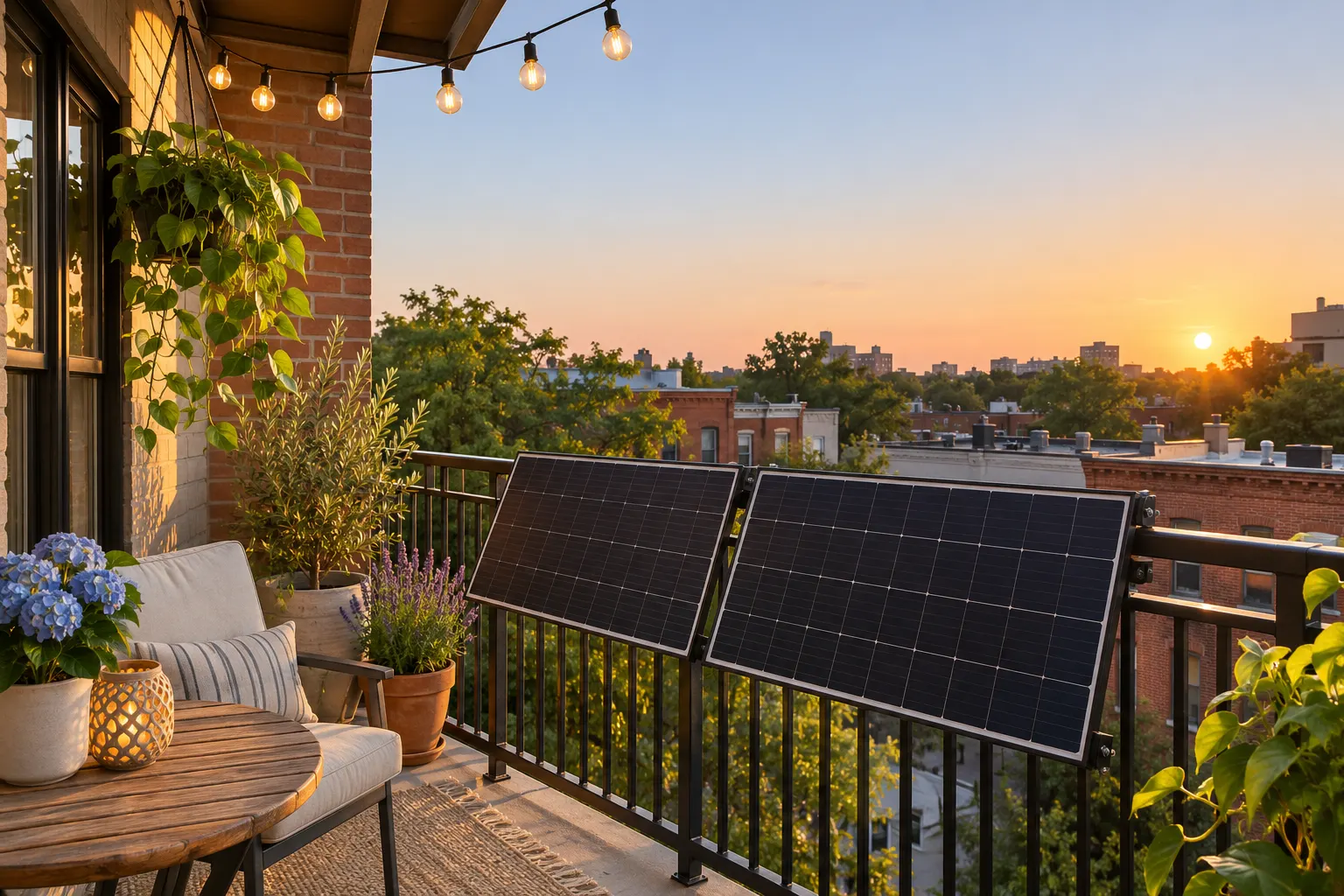
Balcony solar is plug-in solar mounted on a balcony: one or two panels on a railing, a microinverter, and a cord into a standard 120 V outlet. In the US it only recently got its own rules. As of November 9, 2026, ten states have signed laws that let households use these kits without the usual utility interconnection process: Utah, Maine, Virginia, Colorado, Maryland, New Hampshire, Connecticut, Vermont, New Jersey and California. Most cap output at 1,200 W. This guide shows how a balcony solar system works, which states allow it, what it saves, and how to mount it without trouble.
- Law in force
- Signed, starts later
- No state law (not a ban)
- Bill passed, not law
Tap a state to see its rule.
How Balcony Solar Works
A balcony solar kit is the same idea as any plug in solar setup, sized for a small outdoor space. The panels turn light into direct current. The microinverter turns it into alternating current. The cord feeds that power into the wiring of your home, where whatever is already running uses it first.
Panels on the Railing, Microinverter, 120 V Outlet
- 1
Panels
Up to 2,000 W of DC
- 2
Microinverter
Converts DC to AC
- 3
Standard plug
Into a dedicated outlet
- 4
Your home
Appliances use the power first
Kits have three parts: the panels, a microinverter, and a plug that goes into a standard 120 V outlet. Utah’s law spells out the 120 V outlet requirement, and so do Connecticut’s and New Jersey’s. Utah HB 340 (2025) Connecticut PA 26-127, 2026 You mount the panels yourself, run the cord inside, and plug in. There is no roof work.
Safety features matter more than they look. The laws we read require the inverter to stop feeding power when the grid goes down, called anti-islanding, so line workers are not exposed to power from your balcony. Most also require the product to be listed by a recognized testing lab, such as UL. Vermont names UL 3700, a UL outline of investigation for plug-in solar equipment. Vermont Act 149 (2026) An outline of investigation is a testing method, not yet a settled national standard, so what counts as a compliant product can still change.
The 1,200 W Limit
Most state laws cap a balcony solar system at 1,200 W of AC output. That is the case in Utah, Maryland, Connecticut, Vermont, New Hampshire, Virginia, New Jersey and California, and Maine uses the same top figure with extra steps above a lower tier. Utah HB 340; Maryland HB 1532; New Hampshire SB 540, 2026
Colorado is the exception: its law allows up to 1,920 W into the grid, with one system per home and one per outlet. Colorado HB26-1007, C.R.S. 40-2-140, 2026
The cap counts AC output, not panel size. A kit with more panel watts than inverter watts still delivers only what the inverter allows, so compare the inverter rating before the panel rating.
What It Can Power
Balcony solar suits steady loads that run through the day: a refrigerator, a router, a TV on standby, a laptop. When the panels make more than the home is using, the surplus flows out to the grid. In most of these laws you are not paid for that surplus, so a home with people around in the daytime gets more from a kit than an empty one. We do not print a kilowatt-hour figure here, because it depends on your latitude, tilt, shade and railing direction. Our calculator takes those inputs.
Which US States Allow Balcony Solar?
There is no federal ban and no federal rule specific to balcony solar. What decides it is your state law, if you have one, and your utility’s rules if you do not. Here is where each of the ten states stands, with the start date we could verify.
- Utah: 1,200 W, in force since May 7, 2025. No utility approval, fee or extra equipment. Legal Utah HB 340 (2025)
- Colorado: 1,920 W, in force since August 12, 2026. The utility may ask for notice of the system. Legal Colorado HB26-1007, 2026
- Maryland: 1,200 W, in force from July 1, 2026 according to the revised fiscal note. You notify the utility before installing. Legal Maryland HB 1532 fiscal note, 2026
- Vermont: 1,200 W per meter, in force from July 1, 2026. A smart meter is required, and exported energy is not paid. Legal Vermont Act 149 (2026)
- Connecticut: 1,200 W, in force from October 1, 2026. Legal Connecticut PA 26-127, 2026
- Maine: signed April 6, 2026. The start date is not stated in the text we read, so we could not confirm it. Signed, start date unconfirmed Maine LD 1730, P.L. 2026 c. 644
- Virginia: 1,200 W, in force January 1, 2027. You notify the utility before installing, using the State Corporation Commission form. Signed, in force Jan 1, 2027 Va. Code § 56-596.8, 2026
- New Hampshire: 1,200 W, in force January 1, 2027. Signed, in force Jan 1, 2027 NH SB 540, 2026 c. 262 (mirror)
- California: 1,200 W, in force January 1, 2027, with exemptions that expire on January 1, 2030. Signed, in force Jan 1, 2027 California SB 868 (mirror), 2026
- New Jersey: signed September 1, 2026. By our reading of the bill, it starts six months after enactment, around March 1, 2027. Signed, in force around Mar 1, 2027 NJ Governor, 1 Sep 2026
Two caveats on sources. For New Hampshire and California the official legislature sites blocked our automated download, so we read mirrors of the enacted text. Both were checked by hand against the official site on November 9, 2026 for the key facts.
New York and Massachusetts
New York’s SUNNY Act (S8512C / A9111C) passed both chambers on May 28, 2026. The Senate page shows no delivery to the Governor, so it is not law. Passed, not signed NY Senate bill page, 2026 Bills can be delivered late in the year, so this can change. Massachusetts is reported to have a bill moving, but we could not confirm it from an official source.
Every Other State
Where there is no balcony solar law, there is also no specific ban. Your utility’s interconnection rules apply, and those rules were written before plug-in kits existed. We cannot say what each utility will accept. The cautious route is to ask your utility before you install. See state-by-state rules and Is plug-in solar legal in the US?.
Is Balcony Solar Worth It?
No Net Metering in Most Laws
Most of these laws keep balcony solar out of net metering, the system that credits you for exported power. Utah’s does so, Maine’s says no net metering, and Vermont adds that exported energy is not paid. Maine P.L. 2026 c. 644; Vermont Act 149 Connecticut requires a notice that export may be billed as consumption where there is no net metering. Connecticut PA 26-127, 2026
The practical effect: you save by using the power yourself, not by selling it. Balcony solar rewards daytime use.
Kit Prices
Prices move fast in a new market, so we do not print them in the text. Our comparison page shows prices read from each brand’s own store, with the date we read them. See best plug-in solar kits.
Payback
Payback depends on what you pay per kilowatt-hour, how much sun your railing gets and how much of the power you use as it is made. Any single number would be wrong for most homes, so we give none. The plug-in solar calculator works from your own inputs.
Mounting Balcony Solar Safely
Where a state law speaks to mounting, it is cautious. Connecticut says the system must not be fixed to the structure. Connecticut PA 26-127, 2026 Vermont allows temporary fixing, as long as it is secure. Vermont Act 149 (2026) Maine says that if you install on a structure you do not own, you must not compromise it or break building codes, and you restore it when you remove the system. Maine P.L. 2026 c. 644
None of the laws gives wind or weight limits for a railing, so the rest is our editorial advice, not legal rule:
- Use the mounts the manufacturer supplies, and follow its instructions for your railing type.
- A panel is a sail. Treat wind as the main risk, especially on upper floors, and secure every panel with more than one point.
- Check that the railing itself is sound before you add weight to it.
- Keep the cord tidy and away from foot traffic, and plug into an outdoor-rated or protected outlet where one is available.
- Do not use extension cords or power strips unless the manufacturer says so.
If the railing is not yours, get permission before you mount anything.
Balcony Solar for Renters and Condos
This is where most people get stuck. A state law allowing balcony solar does not automatically give you the right to put it on a rented balcony. Only some laws speak to landlords.
What the Laws Say for Tenants
- New Jersey: a tenant gives the landlord or HOA written notice 14 days before installing, with proof the system complies and where it will go. Landlords may not ban it if the tenant pays for the electricity, though they can set reasonable size and placement limits. Rules start around Mar 1, 2027 NJ S2368, P.L. 2026 c. 82
- Vermont: the tenant gives 10 days’ notice. The landlord may impose reasonable restrictions, and if the landlord does not respond in 10 days, the tenant may install. Vermont Act 149 (2026)
- Colorado: from January 1, 2027, covenants that unreasonably ban balcony solar are void, and in a condo you may use an exclusive-use balcony or patio. The owner can still impose reasonable limits and ask for indemnification. Colorado HB26-1007, 2026
- Utah, Maryland, New Hampshire, Connecticut, California: the text we read has no landlord or HOA rule. Your lease and your building’s rules apply.
- Virginia: the law does not apply to rented units where bills are split by a ratio billing system.
Outside these states, the lease and the HOA rules decide. We could not verify any general solar-access law that covers plug-in kits state by state, so ask in writing. Our guide for renters and apartments covers what to say, and the landlord and HOA guide explains what they can refuse.
Balcony Solar With a Battery
Most balcony solar laws deal with the solar side only. Maine is the one we found that says plug-in systems include batteries. Maine P.L. 2026 c. 644 We did not find battery rules in the other nine laws, so we cannot say a battery is allowed or banned there.
Until that is clearer, treat a balcony solar kit with a battery as a separate question. Check your state’s text, ask your utility, and check whether the product carries the safety listing the law demands. A battery does not change the cap on solar output, so a larger store does not mean more power into your home.
Balcony Solar Questions to Settle Before You Buy
- Is my state on the list, and has the law started? Several take effect in 2027.
- Does the kit carry the required safety listing? Look for the lab listing the law names.
- Do I need to tell my utility? Maryland and Virginia require notice before installing, and Colorado lets the utility ask for it.
- Who owns the railing? Landlords, boards and HOAs may need to agree.
- Is the rated output at or under my state’s cap? Check the inverter’s AC rating.
If you can answer all five, you are ready to compare kits.
Sources
Each one opened and checked on November 9, 2026.
- Utah HB 340 (2025), enrolled
- Maine LD 1730, P.L. 2026 c. 644
- Virginia Code § 56-596.8
- Colorado HB26-1007, Session Laws 2026 c. 127
- Maryland HB 1532, 2026 c. 353
- Maryland HB 1532, Fiscal and Policy Note
- New Hampshire SB 540, 2026 c. 262 (text mirror)
- Connecticut Public Act 26-127 (HB 5340)
- Vermont S.202, Act 149 (2026), as enacted
- New Jersey Governor's office, bill action of September 1, 2026
- California SB 868, Stats. 2026 c. 985 (text mirror)
- New York S8512C / A9111C, Senate bill status
Questions people ask
Are balcony solar worth it?
For many households a small kit is worth trying, but not for all. It covers steady daytime loads such as a fridge and router, and most state laws do not pay you for what flows back to the grid. A sunny, unshaded railing and someone home in the day make the best case.
Is balcony solar any good?
It is good at one job: offsetting the electricity your home is already using while the sun shines. It will not run a whole apartment, it makes little in shade, and it does not work as a backup in an outage because the inverter shuts off when the grid goes down.
Which US states allow balcony solar?
Ten states have signed laws: Utah, Maine, Virginia, Colorado, Maryland, New Hampshire, Connecticut, Vermont, New Jersey and California. Start dates differ, and several take effect in 2027. New York has passed a bill but, as of November 9, 2026, we could not find that it has been signed.
Is balcony solar legal in NJ?
New Jersey signed its balcony solar law on September 1, 2026. Our review of the bill text puts the start at six months after enactment, around March 1, 2027. Until then, check with your utility before you plug in. Renters should plan on written notice to a landlord.