
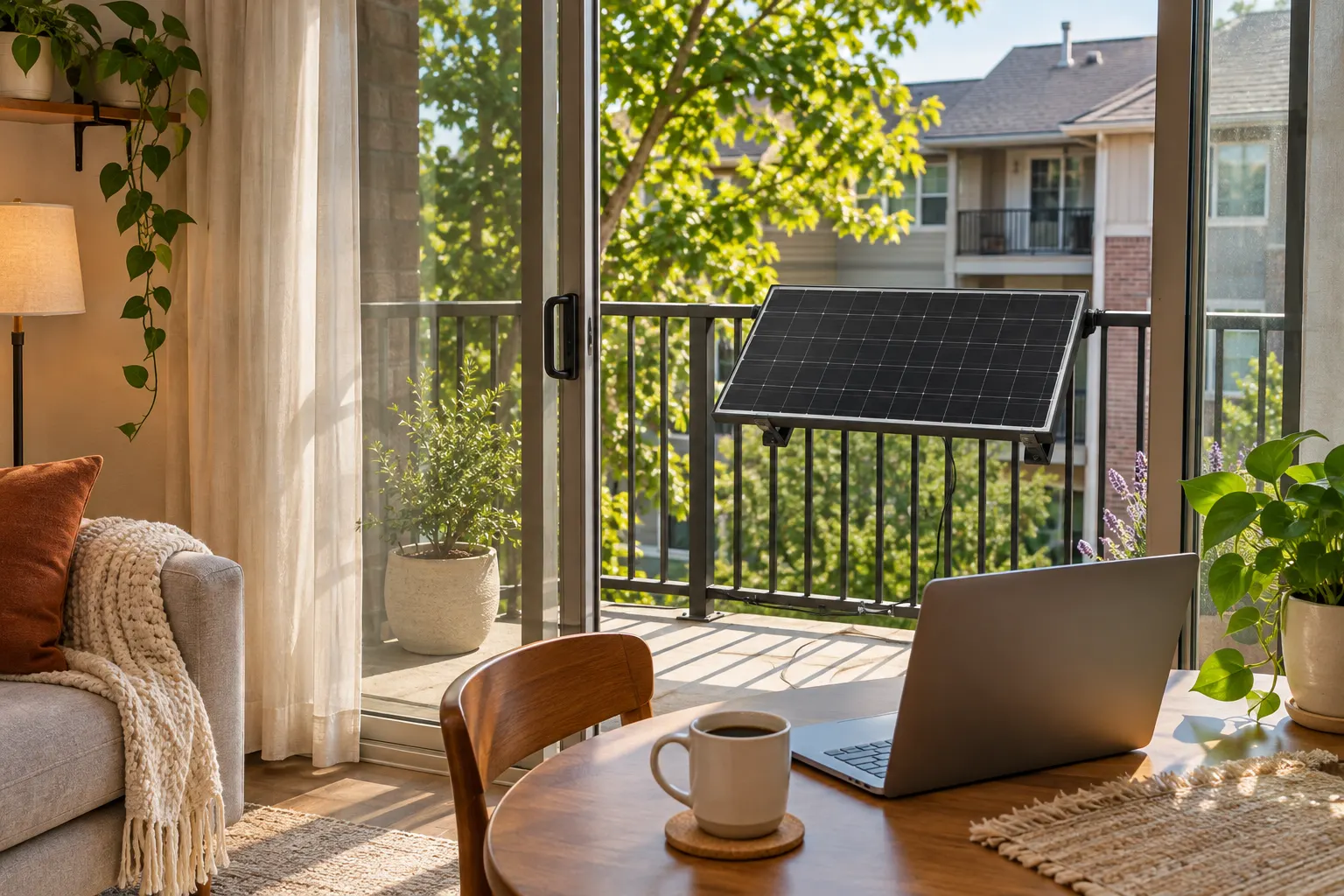
If you rent, solar panels for apartments are no longer a fantasy, but they are not simple either. In 2026 you have three real paths. A plug-in balcony system sends power into your own wall socket. A portable panel and power station charge your devices anywhere. Community solar lets you subscribe to a shared solar farm instead of putting anything on your building. This guide takes them in that order, with the state rules we verified on Nov 9, 2026.
The Short Version
- Ten states have signed plug-in solar laws, and only three of them (New Jersey, Vermont, Colorado) add a clear rule about landlords or condo boards Law in 10 states
- Elsewhere there is no state law and your utility’s interconnection process applies No state law
- Portable panels need no permission from the grid, only from your landlord if you mount them
- Community solar needs no hardware, but availability depends on your state and utility
Can I Put Solar Panels on My Apartment Balcony?
Maybe. A plug-in kit is a small panel and microinverter that connects to a standard 120 V outlet. Our plug-in solar guide explains the parts. For renters, the question is not only whether the state allows the device. It is also whether your landlord, condo board or HOA does, and whether any law overrides them.
- 1
Panels
Up to 2,000 W of DC
- 2
Microinverter
Converts DC to AC
- 3
Standard plug
Into a dedicated outlet
- 4
Your home
Appliances use the power first
The state map below shows which states have a law and which add a renter rule.
- Law in force
- Signed, starts later
- No state law (not a ban)
- Bill passed, not law
- Has a renter or HOA rule
Tap or click a state to see its law, wattage cap, start date and the official source.
States Where the Law Protects Renters
Three states have written the landlord question into their plug-in solar laws.
New Jersey. The Governor’s office says landlords, HOAs and similar bodies cannot broadly ban plug-in solar, and that municipalities cannot ban it or require a permit. NJ Governor's office, 1 Sep 2026 We read the bill text on the legislature site: a landlord cannot prohibit it if the tenant pays the electric bill, though the landlord can set reasonable limits on size and placement. The tenant gives written notice at least 14 days before installing, with proof the system meets the law and where it will go. An HOA or condo association cannot prohibit it, and the landlord or association may require compensation for damage. The law was signed on September 1, 2026 and takes effect six months later, which works out to March 1, 2027. Until then, treat it as signed but not in force. Signed, not yet in force
Vermont. A tenant gives the landlord 10 days’ notice. The landlord can impose reasonable restrictions, including requiring a licensed electrician at the tenant’s cost, and if the landlord does not respond within 10 days, the tenant may install. Without landlord approval there is no electrical work. Covenants cannot ban plug-in solar. Vermont Act 149 (2026) Vermont also requires a smart meter, and the export is not paid.
Colorado. From January 1, 2027 nobody may unreasonably prohibit plug-in solar, and covenants that do are void. In a condo or other common interest community you can install on a balcony or patio you have exclusive use of. The owner may still require advance notice, reasonable limits on fire risk, overloading and placement, secure fixing and compensation for damage. Colorado HB26-1007, chapter 127, 2026
States With a Law but No Renter Rule
Utah, Maryland, New Hampshire, Connecticut and California have plug-in solar laws, but we found no landlord or HOA provision in their text. UT HB 340; MD HB 1532; NH SB 540; CT PA 26-127; CA SB 868, 2026 That means the device may be allowed, but your lease and building rules still apply. A permitted product does not give you a right to hang it off a rented balcony.
Two more states need a note.
- Virginia. The law does not apply to a rented unit where the electric bill is split with a RUBS method (ratio utility billing). Va. Code 56-596.8, 2026 There is no landlord rule either, and the law takes effect on January 1, 2027.
- Maine. If you install on a structure you do not own, you must make sure you do not compromise it or break codes, and you must restore it when you remove the system. It gives no express right against a landlord. Maine P.L. 2026 c. 644 We could not confirm the exact date it took effect.
States With No Law
The rest of the country has no plug-in solar law. That is not the same as a ban. There is no federal prohibition and no federal rule of its own, so what governs is your utility’s interconnection process and the electrical code your state has adopted. We read the pattern of the new laws as a sign that these requirements apply without one, but we could not confirm it utility by utility. Do not assume a kit is allowed on the grid in these states, and ask your utility before you plug in. Our legal guide lists each state with its source.
New York’s SUNNY Act passed both chambers but had not been delivered to the Governor when we checked, so it is not law. Not law yet
How to Ask Your Landlord or HOA
In every state, a short written request does more than an argument. Make it easy to say yes.
- Name the product. Include the model, wattage and maximum output.
- Show certification. Where the state names one, quote it. New Jersey and Vermont refer to UL 3700 or an equivalent. Vermont Act 149 (2026)
- Say where it goes. Name the balcony rail, patio or wall, and how it will be fixed. Mounting should be secure and removable.
- Cover safety and cost. Offer to carry insurance, pay for any electrician the landlord requires and compensate for damage.
- Promise removal. Say you will take it down and restore the surface when you move out.
- Ask for a reply date. In New Jersey and Vermont this timing has legal weight, so use the statutory wording where it applies.
In New Jersey the notice must be written, at least 14 days before installation, and carry proof of compliance and the location. In Vermont the 10 day clock starts at your notice. In other states, treat the same dates as courtesy deadlines, not rights.
If you live in an HOA or condo, ask the board in writing and read the bylaws first. Many boards regulate balcony rails, exterior fixtures and shared electrical circuits.
For more on leases and boards, see our landlord and HOA guide.
Portable Solar Panels for Renters
A portable kit is a different product. It is a foldable panel plus a battery power station, from brands such as Anker, Jackery and EcoFlow, sold on Amazon.com and elsewhere.
What it does well: you can charge a laptop, phone, lights, a fan or a small cooler, and take it with you when you move. What it does not do is power your apartment from the wall. It does not plug into a household circuit, so it is not a plug-in grid system and it will not reduce your electric bill directly. The power stays in the battery until you use it.
That matters for the permission question. A portable panel on a table or the floor of a balcony is usually just a gadget. Hanging it off a rail with brackets raises the same lease questions as any fixed installation. If you use it as backup power, it is a reasonable fit for renters because it is easy to pack up and the electrical code is not involved.
We do not print kit prices here because they change often. Our kit guide shows what each brand sells and the date we checked.
Community Solar
Community solar is solar without hardware on your building. You subscribe to a share of a solar array somewhere else, and in many programs the utility credits that share on your bill. Renters can often join because nothing is installed at home.
How it works varies. Availability depends on your state and utility, and the terms, credits and any fees differ by program. We have not researched state programs for this guide, so we give no savings figures and no list of states. Read the contract carefully: ask how long you commit, what happens when you move and how the credit shows up on your bill.
Community solar and balcony solar do different jobs. Balcony solar produces power at your home and covers part of your daytime use. Community solar gives you credits for power generated elsewhere. You can in principle do both, but neither replaces the other.
Lease, Deposit and Moving Out
Even with permission, treat the balcony like any other part of the unit that is not yours.
- Get it in writing. An email reply from the landlord or property manager is better than a verbal yes. Ask that it be added to your lease file.
- Protect the surface. Use clamps or brackets that do not drill into a railing, wall or floor unless the landlord agrees. Take photos before you start.
- Expect to restore. Maine’s law states the principle clearly: whoever installs on a structure they do not own must leave it as they found it. Maine P.L. 2026 c. 644 It is a sensible rule for every renter, whatever your state says.
- Plan the exit. Take the system down before the final inspection, patch any holes and photograph the result. That evidence protects your deposit.
- Check insurance. Tell your renters’ insurer you have a solar device, and ask the landlord about the building policy. No state law we read requires a specific policy.
Where a state requires notice to the utility, such as Maryland (before installing) or Virginia (before installing, through the SCC form), the paperwork moves with you or restarts at your next home. MD HB 1532; Va. Code 56-596.8, 2026
What to Do Next
If you live in New Jersey, Vermont or Colorado, start with the notice rules above and the pack. If you live in another law state, ask your landlord first and keep it in writing. If your state has no law, ask your utility and your landlord before buying anything that plugs into the wall, and consider a portable kit or community solar in the meantime.
Solar panels for apartments work best when you know which of the three paths fits your home, your landlord and your state. Start with the permission, then pick the product.
Sources
Each one opened and checked on November 9, 2026.
- New Jersey Governor's office, signing release for S2368 (September 1, 2026)
- Vermont S.202, Act 149 (2026), as enacted
- Colorado HB26-1007, Session Laws 2026, chapter 127
- Maine LD 1730, Public Law 2026, chapter 644
- Virginia Code section 56-596.8
- Utah HB 340 (2025), enrolled
- Maryland HB 1532, 2026 chapter 353
- New Hampshire SB 540, 2026 chapter 262 (text mirror)
- Connecticut Public Act 26-127 (HB 5340)
- California SB 868, chapter 985 (text mirror)
Questions people ask
Can I put solar panels on my apartment balcony?
Sometimes. A handful of states now have plug-in solar laws, and New Jersey, Vermont and Colorado add protections for renters or condo owners. Everywhere else your lease or condo rules decide. Even where the law is on your side, give written notice and check the product's certification first.
Why do people say no to solar panels?
Common reasons are cost, shade, roof or building restrictions and not owning the property. Renters hit the last one hardest, because a landlord controls the building. Plug-in and portable kits sidestep much of this since they need no roof work, though a balcony still needs permission in most states.
Are portable solar panels good for renters?
They are good for charging a power station, phone or laptop, and you can take them with you when you move. They do not feed your home's wiring or lower your bill the way a plug-in kit does, so judge them as backup and travel power, not as a replacement for grid electricity.
Can I use window solar panels in an apartment?
Small window panels can charge a phone or a power bank when sunlight comes straight through the glass. Glass and window film reduce output, and a window rarely gets full sun. We found no law covering them, but check your lease for anything about fixtures or window changes.
Can my landlord say no to plug-in solar?
In most states, yes, because no state law stops them. New Jersey bars landlords from broadly banning it when the tenant pays the electric bill, and Vermont lets a tenant proceed if the landlord does not answer within 10 days. Elsewhere your lease and the landlord's consent decide.