
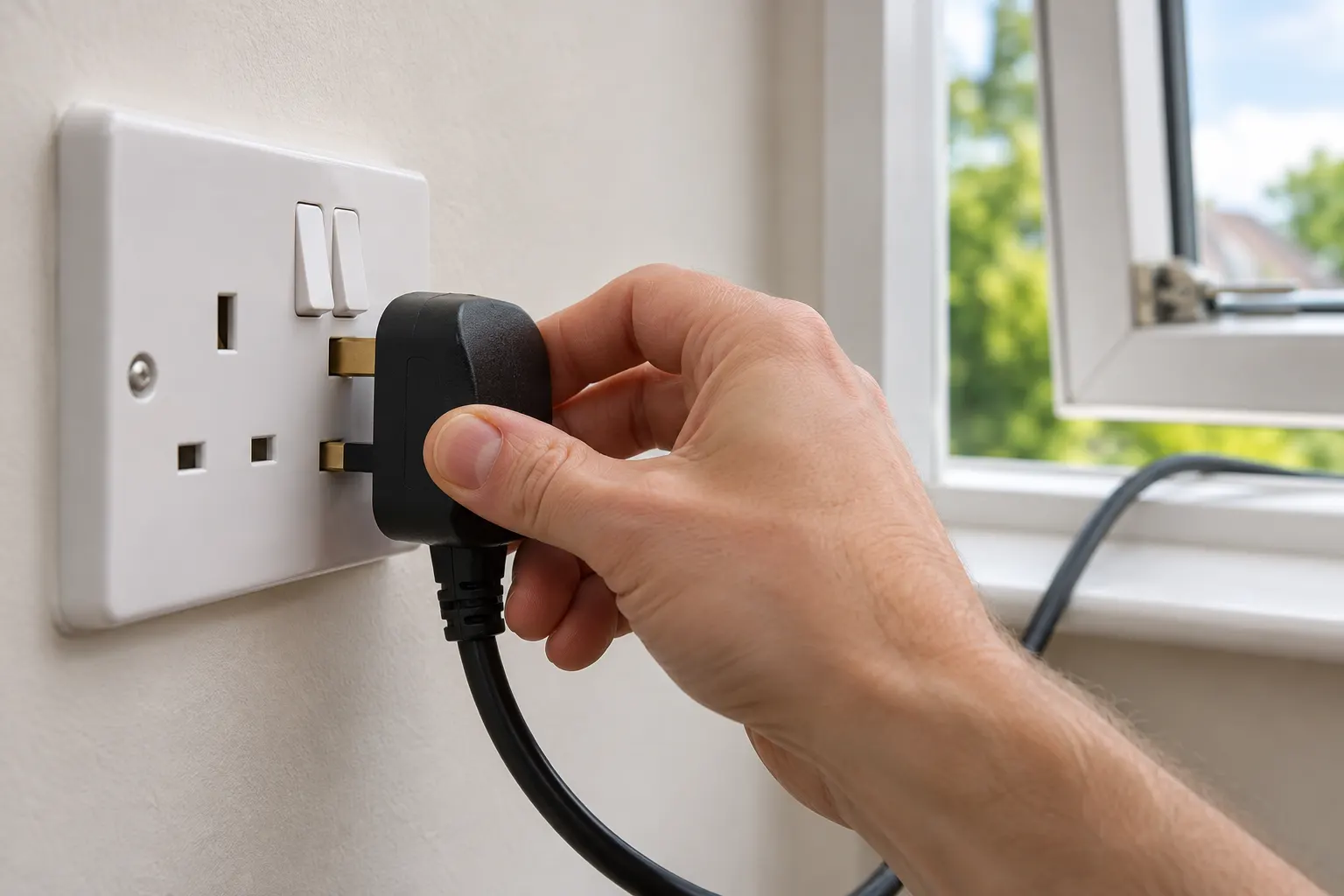
Yes. Plug-in solar has been legal in England, Wales and Scotland since 27 August 2026. SI 2026/848 reg. 1 The catch is the rules around it: 800 W AC at most, one device per home, no battery, and registration on myplugin.solar before you use it. Northern Ireland is not covered in practice. SI 2026/848 reg. 1(3)-(4)
If you ask whether plug in solar is legal in the UK, this page is the long answer. Every line below names its source and the date we checked it. Where official documents disagree, or where we could not find a rule, we say so rather than guess. For the practical side, start with our plug in solar guide.
The Short Version
- Great Britain: legal since 27 August 2026 Legal
- Northern Ireland: no covering law found No law yet
- Battery inside the plug-in unit Not allowed
- Output: 800 W AC at most, panels up to 2,000 W
- One device per home, registered on myplugin.solar before you use it
Can I? Four questions
Check what applies to your home
The Law: SI 2026/848
The legal change is one statutory instrument. It does not create a new licence or a registration scheme. It removes the rule that stopped you plugging a generator into a socket, and it attaches conditions.
What It Changed
The instrument is the Plugs and Sockets etc. (Safety) Regulations 1994 and Electricity Safety, Quality and Continuity Regulations 2002 (Amendment) Regulations 2026, SI 2026/848. It was made on 16 July 2026 and laid before Parliament the next day. SI 2026/848 It came into force on 27 August 2026. SI 2026/848 reg. 1(2) DESNZ confirmed on 26 August 2026 that plug-in solar was legal across Great Britain. DESNZ news, 26 Aug 2026
In practice the plug rules say that a generator may not be connected through a normal BS 1363 plug, and the amendment carves out an exception for approved plug-in solar devices. The product must be a compliant device, and the plug must be approved by a notified body. SI 2026/848 reg. 2(2) and 3(3)
The Legal Definition
The regulations define a plug-in solar device by what it is, not by a brand. It is a solar generator that:
- has a maximum rated alternating current output not exceeding 800 watts
- connects through an ordinary plug and socket to a low voltage installation
- runs in parallel with the grid
- has no battery, apart from control or auxiliary functions
The same definition is the reason a unit with a battery inside falls outside the law, which we cover in its own section below.
800 W, Not 800 VA
You will see “800 VA” in some places. The regulations say watts. The instrument speaks of a maximum rated alternating current output not exceeding 800 watts, while the product specification talks about apparent power of 800 VA. SI 2026/848 reg. 2(3); DESNZ interim product specification v2 Ofgem’s decision uses a registered capacity of 800 W. Ofgem decision DCRP/MP/26/02, 2026
For buying, use 800 W AC. It is the figure in the law, and it is the one to compare against an inverter’s rated output.
The Product Rules (Interim Product Specification v2)
The regulations rely on a technical document: the Plug-in Solar Device Interim Product Specification, version 2, published by DESNZ on 16 July 2026. DESNZ interim product specification v2, 2026 A kit has to meet it, and the seller should say so plainly on the box or the listing. The word “interim” matters: the specification can be replaced, so check our verified date before relying on a detail.
Plug and Socket
There is no special plug. The device uses a standard BS 1363-1 plug, approved by a notified body as an exception to the usual bar on connecting generators, and it goes into a fixed BS 1363-2 socket. SI 2026/848 reg. 2(2) and 3(3); Explanatory Memorandum §5.1 If a kit arrives with a different connector or an adaptor in the box, it is not the product the law describes.
Up to 2,000 W of Panels
Two limits sit side by side. The inverter may output 800 W AC. The panels connected to it can total up to 2,000 W of direct current. SI 2026/848 Explanatory Memorandum §5.1 Oversized panels do not push more into your home: what reaches the wiring is capped at 800 W.
Where You Cannot Mount It
The specification rules out ACM, MCM, HPL and timber cladding, timber balconies, and any building undergoing external wall remediation. The mounting must be reversible and not permanent. DESNZ interim product specification v2, §8.3.2, 2026 If you do not know what your building is clad in, ask the owner or managing agent before you buy.
One Device per Home and Registration
The regulations make the device legal. The grid rules decide how many you can run and who you tell.
Why One, Not One per Circuit
The product specification and the government response say one device per final circuit, subject to a change to the G98 connection standard. Ofgem then approved a G98 change that limits it to one per installation, meaning one per home, and that tighter limit is the one that applies. Ofgem decision DCRP/MP/26/02; DESNZ government response, July 2026 So a second kit on another circuit does not get you around it. DESNZ interim product specification v2, §1 note, 2026
Registering Your Device
A compliant plug-in solar device (solar only, 800 W AC at most, listed on the ENA type test register) is not notified with a G98 Form B. You register it on the UK plug-in solar website, myplugin.solar, with your name, your postcode and the make and model of the device. Electricity North West, plug-in solar, 2026 The Ofgem decision says removal must be notified too. Ofgem decision DCRP/MP/26/02, 2026 The same decision exempts the consumer from needing a competent installer, so you can fit it yourself. The G98 connection standard still applies to hard-wired installs and larger generation.
Your network operator, the company that runs the local wires, is not your energy supplier. The two are often different businesses. You can find yours with the ENA’s Who’s my network operator? postcode tool.
When to Register
Register before you use the device. The regulations say the network operator must be advised “before, or at the time of, commissioning”, so there is no 28-day grace period after you plug in. ESQCR 2002 reg. 22(2)(c), as amended by SI 2026/848 Check that the exact model is on the ENA Connect Direct type test register first.
Wiring Rules (BS 7671)
Your home’s fixed wiring is still covered by BS 7671:2018+A4:2026. Any change to a circuit is electrician’s work, even though plugging in is not. If you have no modern RCBO protection, or still have old fuses, have an electrician check the circuit first. DESNZ interim product specification v2, §8.3.2; Ofgem decision, 2026
Extension leads, multi-way adaptors, RCD adaptors and travel adaptors are not allowed. The kit goes into a fixed wall socket and nothing else sits between them. If the socket is in the wrong place, the fix is a new socket installed by an electrician, not a longer cable.
Planning Permission
Electrical law and planning law are separate. The order that made the kit legal to plug in did not itself deal with planning, and a second instrument did.
England: Permitted Development
In England, SI 2026/896 made installation permitted development from 27 August 2026. The limits are that panels stick out no more than 0.2 m from a wall facing a highway and 0.4 m in other cases. It is not allowed on a wall, balcony or fence made of timber, or on a timber-clad facade. SI 2026/896 The order also applies to blocks of flats.
Scotland and Wales
SI 2026/896 amends England’s permitted development rules only. For Wales, the order says it extends to England and Wales but changes only the English rules. We could not confirm an equivalent planning rule for Scotland or Wales. SI 2026/896 That does not mean permission is required, only that we found no rule that says it is not. Ask your local planning authority before you fix anything to the outside of the building.
Listed Buildings and Conservation Areas
The English permission carves out listed buildings, scheduled monuments and conservation areas where the wall faces the highway. SI 2026/896 The product specification also tells users to get planning permission and listed building consent where they apply. DESNZ interim product specification v2, 2026 In those places, treat “permitted development” as a no until your council says otherwise.
Northern Ireland
No law yetNorthern Ireland is not covered in practice. Regulation 3, which allows use, extends only to England, Wales and Scotland. SI 2026/848 reg. 1(3)-(4) Northern Ireland has its own electricity safety regulations and its own connection standard. The product specification says application there is subject to further consideration. DESNZ interim product specification v2, 2026
The sources even disagree on wording. The Explanatory Memorandum describes the instrument as extending to the whole UK, DESNZ says “Great Britain”, and MCS writes “across the UK”. The regulation that grants the permission is the one that decides, and it stops at Great Britain. SI 2026/848 EM §4.3-4.4; reg. 1(4) We could not confirm a decision by the Department for the Economy. Until one appears, do not assume a kit is allowed there. That is different from saying it is banned: we found no rule either way.
Batteries Are Still Not Allowed
Not allowedA plug-in device with a battery is still not permitted. The definition excludes batteries, and the Ofgem decision confirms it. SI 2026/848 reg. 2(3)(e) This applies to sale, supply and use of a unit that combines the two. A battery sold as a separate product is a different case, covered in our plug-in solar battery guide.
MCS and the Smart Export Guarantee
MCS says plainly that, as a do-it-yourself system, plug-in solar is not included in the scope of MCS. MCS, 14 Sep 2026 The Smart Export Guarantee requires installation by an MCS installer using certified products, or an equivalent scheme. MCS, SEG for consumers, 2026 Put together, there is no documented route to export payments today, and we found no Ofgem or DESNZ source that creates one. Ofgem, SEG for generators, 2026
One seller says its kits carry MCS accreditation. MCS says plug-in solar is outside its scheme, and we follow MCS. Ask any seller for the certificate behind that claim.
Renters and Leaseholders
No law gives tenants a right to install plug-in solar. The product specification makes manufacturers warn that users must get any permissions from the owner, landlord, freeholder, managing agent or relevant authority before installing. DESNZ interim product specification v2, 2026 DESNZ says decisions on requests are “a matter for landlords, freeholders or councils”. DESNZ news, 26 Aug 2026
We read the Renters’ Rights Act 2025 for a provision on solar and found none. Claims that it gives tenants a right to panels cite no primary source. Our renters guide and landlord and insurance guide cover how to ask and what to tell your insurer.
What Is Still Unclear
Some points are open, and we would rather say so than fill the gap. As of 9 November 2026:
- 800 W or 800 VA. The law says watts; the specification says apparent power. We use 800 W AC.
- One per home or per circuit. Official documents differ; the tighter G98 limit of one per home applies.
- Northern Ireland. The documents point different ways. We could not confirm a decision.
- Export payments. No documented route to the Smart Export Guarantee, and no date for one.
- Planning in Scotland and Wales. We could not confirm an equivalent to the English permitted development rule.
We update this page when a source changes, and the verified date at the top moves with it. For the wider picture, go back to the plug in solar guide.
Sources
Each one opened and checked on 10 November 2026.
- SI 2026/848, the Plugs and Sockets etc. (Safety) and ESQCR (Amendment) Regulations 2026
- SI 2026/848, Explanatory Memorandum
- DESNZ, Plug-in Solar Device Interim Product Specification v2 (16 July 2026)
- DESNZ, Plug-in solar: government response (July 2026)
- Electricity North West, plug-in solar (register on myplugin.solar)
- ESQCR 2002, regulation 22 (as amended by SI 2026/848)
- Ofgem, decision on DCRP/MP/26/02 (G98 for plug-in microgeneration)
- SI 2026/896, permitted development for plug-in solar (England)
- DESNZ news, 26 August 2026: plug-in solar panels come to market
- MCS, response on plug-in solar (14 September 2026)
- MCS, Smart Export Guarantee for consumers
- Ofgem, Smart Export Guarantee (SEG) for generators
Questions people ask
Is balcony solar legal in the UK?
Yes, in Great Britain. Plug-in solar, which includes balcony kits, has been legal to buy and use in England, Wales and Scotland since 27 August 2026. The kit must be limited to 800 W AC, meet the government's product specification and have no battery. Northern Ireland is not covered.
Is it legal to install your own solar panels in the UK?
A plug-in kit, yes: Ofgem's decision lets the consumer install it without a competent installer, provided you register the device on myplugin.solar before you use it. Larger roof systems are different and normally go through an installer. For a plug-in kit, the 800 W AC limit, the one-per-home rule and the no-battery rule all apply.
When will plug-in solar be legal in UK?
It already is in Great Britain: the regulations came into force on 27 August 2026. In Northern Ireland the legal permission does not extend there, and the government says its position is subject to further consideration. We could not confirm any date for a decision.
Is plug-in solar safe?
Compliant kits are designed to be. DESNZ says the change followed independent safety testing, and the product specification requires anti-islanding, so the unit switches off if the grid goes down. Safety also depends on you: a fixed socket in good condition, no extension leads and no adaptors.
Do I need to tell my energy supplier about plug-in solar?
No. You register the device on myplugin.solar before you use it, with your name, postcode and the make and model, and the duty is owed to your network operator, not your supplier. Removal must be notified too. Your supplier is a separate company, though it is sensible to check your tariff and whether you are paid for exported power. By default you are not.
Is plug-in solar legal in Northern Ireland?
Not as far as we could confirm. The regulation that allows use does not extend to Northern Ireland, and the product specification says its application there is subject to further consideration. That is not a ban, but we found no rule that covers it. Do not assume a kit is allowed.