
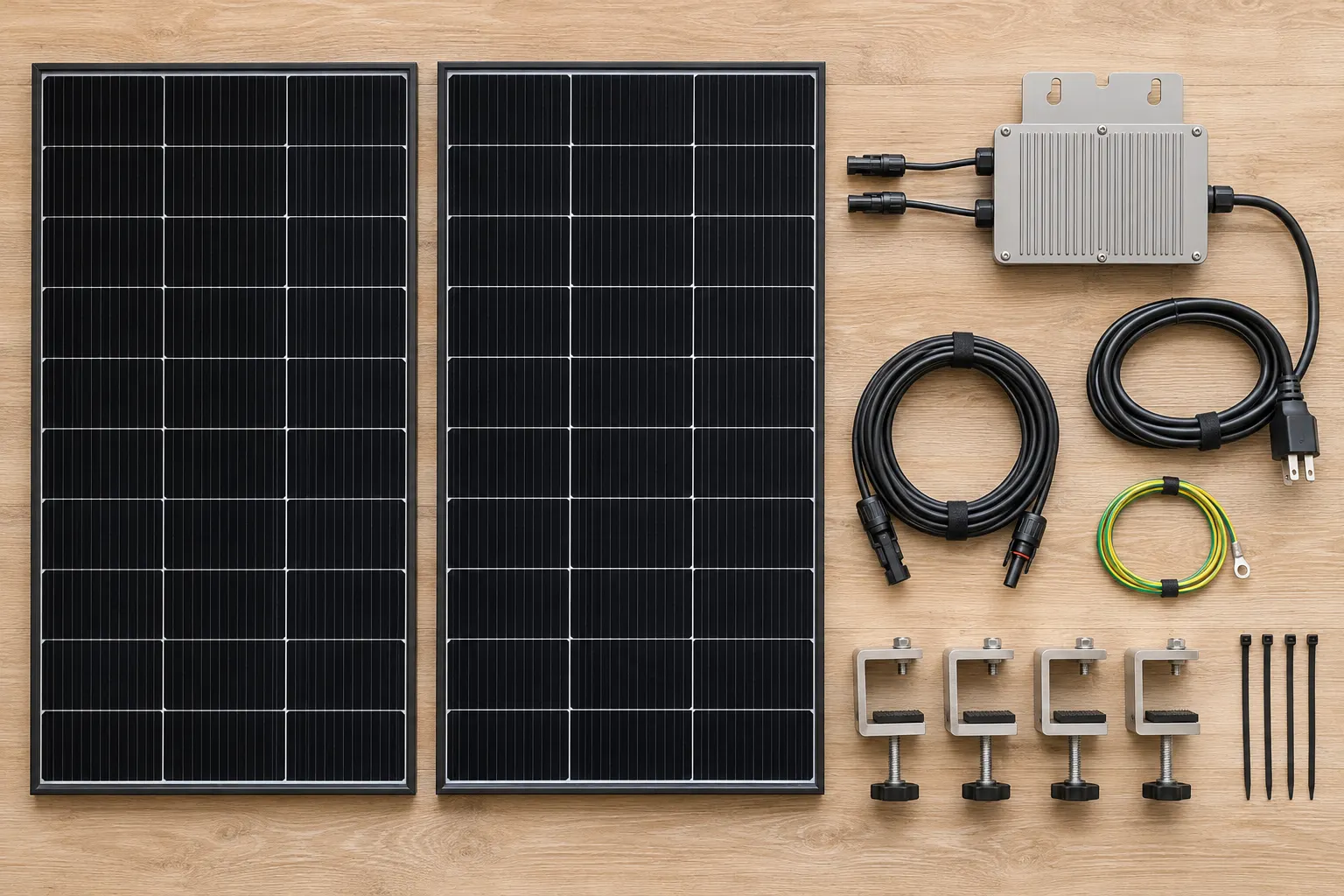
A plug in solar kit is one or more panels, a microinverter and a cord that goes into a standard outlet. This guide lists the kits we found for sale in the US, with the price and the specs exactly as each brand’s store showed them on November 9, 2026. The rule that decides which kit is right for you is your state’s limit, which is 1,200 W in most laws Utah HB 340, 2026 and 1,920 W in Colorado Colorado HB26-1007, 2026. Below the table, each kit gets a short entry that says what is documented and what is only the seller’s word.
We did not buy or lab-check any of these kits. We read the store pages, wrote down what they say, and mark every certification that is a seller’s statement.
The Kits at a Glance
| Kit | AC output | Panels | Certification | Price | Store |
|---|---|---|---|---|---|
| US Solar Supplier1180W Plug-In Solar Kit (APsystems EZ1 + 2 x HanerSun 590 W)The APsystems EZ1-LV-NA is rated 900 VA maximum AC output, under the 1,200 W cap in state laws. | 900 WFits a 1,200 W cap | 1,180 WNo battery · 120 V outlet | Not stated on the kit page | $899read Nov 9, 2026 | US store |
| US Solar Supplier880W Plug-In Solar Kit (Hoymiles + 2 x HanerSun 440 W)AC rating of the microinverters is not given on the kit page. | Not statedCheck the AC rating | 880 WNo battery · 120 V outlet | Not stated on the kit page | $629read Nov 9, 2026 | US store |
| PluggedSolarPlug-in & Balcony Solar System, 4 x 200 WPrice without mounting; roof or ground mounting adds $100 to $200. Also sold as 400, 1,200 and 1,600 W. AC rating not stated. | Not statedCheck the AC rating | 800 WNo battery · 50 ft cord, 110/120 V outlet | UL 3700 and UL 1741 (seller's statement) | $1,595read Nov 9, 2026 | PluggedSolar store |
| CraftStrom800 Watt Plug&Play SolarTwo 350 W inverters and a smart meter. Sold as zero-export: the seller says it does not feed power back to the grid. | 700 WFits a 1,200 W cap | 800 WNo battery · Standard outlet | ETL to UL 1741 and IEEE 1547 (seller's statement) | $1,846.65read Nov 9, 2026 | CraftStrom store |
| EcoFlowSTREAM Microinverter (inverter only)Bundles with panels were sold out when we checked. EcoFlow says plug-in use is currently permitted in Utah, Maryland, Connecticut and Colorado. | Not statedCheck the AC rating | Not statedNo battery · Outlet cable | UL 1741 (seller's statement) | $369read Nov 9, 2026 | EcoFlow store |
Prices read on each brand's own store on Nov 9, 2026; they change often. Certifications are as stated by the seller; we have not seen the certificates. We compare published specifications; we have not tested these kits.
Three things to keep in mind when you read the table. Prices are the brand’s own, read on one day, and they change. An “AC not stated” kit may well fit your state, but the page does not let us confirm it. And “seller’s statement” means we saw the claim on the store page but not the certificate itself.
How We Chose These Kits
We started from the kits a US buyer can actually order from the maker’s own store, then kept the ones whose page gave enough detail to compare. The yardsticks come from the laws, not from marketing.
Your State’s Cap
State laws cap the plug-in system at 1,200 W in Utah, Maryland, Connecticut, Vermont, Maine, Virginia, New Hampshire, New Jersey and California, and at 1,920 W in Colorado. Utah HB 340, 2026 New Hampshire and California define the cap as AC output. NH SB 540 and CA SB 868, 2026 That is why the inverter’s AC rating matters more than the panel total. Kits with 1,180 W of panels but a 900 VA inverter sit under a 1,200 W cap on their AC side.
Certification: UL 3700 and Other Listings
Several laws ask for a listing from a nationally recognized testing laboratory (NRTL). Maine and Vermont name UL 3700. Maine LD 1730, 2026 UL 3700 is an Outline of Investigation for interactive plug-in photovoltaic equipment, not yet a consolidated ANSI standard. Connecticut asks for UL 1741. Connecticut Public Act 26-127, 2026 None of the store pages we read links a certificate. We report the claim and nothing more.
Anti-Islanding
Most state laws require the inverter to shut off when the grid goes down. Maine’s text gives a 0.2 second shutoff. Maine LD 1730, 2026 None of the kit pages we read gives a shutoff time, so ask the seller for the inverter’s datasheet and the certificate that covers anti-islanding.
What We Left Out
BigBlue: the product link we followed went to its European store, and we could not confirm a US store or US price, so it is not here. Anker and Jackery: we found no plug-in solar product for sale in the US from either.
The Kits
US Solar Supplier 1180W Plug-In Solar Kit
An APsystems EZ1-LV-NA microinverter, rated 900 VA maximum, with two HanerSun 590 W panels. That makes 1,180 W of panels on a 900 VA inverter, $899. The kit page does not state a certification. The 900 VA figure is under the 1,200 W cap in the state laws, which makes this the easiest kit in the group to fit to a cap on paper. It plugs into a 120 V outlet. No battery.
What to ask first: for the listing certificate of the EZ1-LV-NA, since the page does not give one.
US Solar Supplier 880W Plug-In Solar Kit
Two Hoymiles microinverters with two HanerSun 440 W panels, $629, the lowest price we found for a complete kit. The page does not give the microinverters’ AC rating, and it does not state a certification. With 880 W of panels, the system should fit under the 1,200 W caps, but we could not confirm the AC figure from the page. Ask the seller for the model number and its datasheet before you buy.
PluggedSolar 800 W Kit
Four 200 W panels with an APsystems microinverter, a 50 ft cord for a 110/120 V outlet and Wi-Fi monitoring, $1,595 without mounting. Roof or ground mounting adds $100 to $200. The page says “UL 3700 certification for Plug-in Solar” and mentions UL 1741 anti-islanding. Both are the seller’s statement: we did not see a certificate. The page also does not state the inverter’s AC output. PluggedSolar sells the system in 400, 1,200 and 1,600 W sizes too, and a 1,600 W system will not fit a 1,200 W cap whatever the label says. Be sure to compare the AC rating, not the panel total.
CraftStrom 800 Watt Plug&Play Solar
Four 200 W bifacial panels with two 350 W inverters (700 W AC) and a smart meter, $1,846.65, the priciest kit here. CraftStrom sells it as zero-export: it says the system does not feed power back to the grid and needs no interconnection agreement. The page says the kit is “ETL certified to UL 1742 and IEEE 1547”. We quote it exactly as written. The other sellers cite UL 1741, so “1742” may be a typo, but we have not seen the certificate, so treat it as a seller’s statement and ask for it. The AC side, 700 W, is under every cap. The zero-export design is interesting where a utility objects to exported power, and we discuss it further below.
EcoFlow STREAM Microinverter
The only EcoFlow product we could buy on November 9, 2026 was the inverter alone, $369. The bundles with one, two or four panels were sold out. The page says “UL 1741”, which is the seller’s statement. EcoFlow’s own note says plug-in use is “currently permitted in Utah, Maryland, Connecticut and Colorado”, a useful signal of where the maker itself will stand behind the product. The AC rating is not stated on the page we read. If you already own suitable panels, the inverter is the part you need; if you don’t, wait for stock or choose another kit.
Match the Kit to Your State
The laws differ in cap, start date and what you must do. This table covers the states where a law has been enacted. “In force” means the law is already in effect as of our check. “Signed” means the governor signed it and it is not yet in force. The kits above list 700 W to 1,180 W of AC or panels, so the cap column and the notes are what separate them.
| State | Status | Cap | Start date | What to watch |
|---|---|---|---|---|
| Utah | In force | 1,200 W | May 7, 2025 | No notice. Utility cannot require approval or a fee. |
| Colorado | In force | 1,920 W | August 12, 2026 | The utility may require notice of the system and size. |
| Maryland | In force | 1,200 W, one per meter | July 1, 2026 | Notify the utility before installing. |
| Connecticut | In force | 1,200 W, one per meter | October 1, 2026 | UL 1741 listing required. |
| Vermont | In force | 1,200 W per meter | July 1, 2026 | Smart meter required. Export is not paid. |
| Maine | Signed | 1,200 W | Date not confirmed | Over 420 W: electrician, dedicated circuit, 30 day notice. |
| Virginia | Signed | 1,200 W | January 1, 2027 | Notify first, on the SCC form. |
| New Hampshire | Signed | 1,200 W AC | January 1, 2027 | Utility may offer a way to report afterward. |
| New Jersey | Signed | 1,200 W | March 1, 2027 (six months after enactment) | No interconnection or fees from the utility. |
| California | Signed | 1,200 W AC | January 1, 2027 | Utility may ask for a simple online registration. |
A few specifics. Utah’s law lets the utility demand no approval, fee or extra equipment. Utah HB 340, 2026 In Maine, every kit in this guide is above 420 W of panels, so the electrician rule applies to all of them. Maine LD 1730, 2026 In Colorado, a larger system is allowed, up to 1,920 W, but none of the kits here is sold at that size. Colorado HB26-1007, 2026 Vermont requires a smart meter, and says you will not be paid for what you export. Vermont Act 149, 2026
New York: the SUNNY Act passed both chambers on May 28, 2026, but it had not been delivered to the Governor when we checked. It is not law. NY Senate S8512C, 2026 Passed, not signed
Every other state has no plug-in law. That does not mean a kit is banned. It means there is no state law; your utility’s interconnection process applies, and we could not check each utility. See the state-by-state map in our state guide and our legal overview in Is Plug-In Solar Legal in the US?
Kits With Batteries
Maine’s law includes plug-in batteries in its scope. Maine LD 1730, 2026 For the other states we could not confirm how the plug-in laws treat a battery, so we are not recommending a battery kit as a plug-in product anywhere else. Every kit in the table above is panels and an inverter with no battery. CraftStrom sells separate batteries; we have not checked how its battery products fit any state’s law.
“Legal in All 50 States” Claims
CraftStrom’s store says its zero-export kit needs no interconnection agreement. That is the seller’s description, and we cannot verify it against each utility. Here is what we can say from the state texts. Many state laws say a plug-in system is exempt from interconnection requirements, which suggests those requirements apply by default where no law exists. That is our inference, and we could not verify it utility by utility. A zero-export design may help where a utility’s concern is power flowing back to the grid, but it does not by itself settle the utility’s rules in a state with no law. If you are in one, call your utility and ask before you install. For more on states without a law, see our plug-in solar legal guide.
Renting or Living in an Apartment
A kit that clamps to a railing suits an apartment, but your lease and building rules still apply, and most state laws are silent on landlords. Colorado, Vermont and New Jersey have renter provisions. Our renters and apartments guide covers the details.
What to Do Next
Pick your state, read its cap, and then compare AC ratings, not panel totals. Ask any seller for the certificate behind a UL claim. And estimate what a kit would actually make for you with our plug-in solar calculator. For the basics, start at what plug-in solar is.
Sources
Each one opened and checked on November 9, 2026.
- Utah HB 340, enrolled text
- Maine LD 1730, P.L. 2026 c. 644
- Va. Code § 56-596.8
- Colorado HB26-1007, Session Laws 2026 c. 127
- Maryland HB 1532, fiscal note
- New Hampshire SB 540, chapter 262
- Connecticut Public Act 26-127
- Vermont Act 149, as enacted
- NJ Governor's release, September 1, 2026
- California SB 868, chapter 985
- NY Senate, S8512C
Questions people ask
What is the best plug in solar kit?
It depends on your state's cap and on what the seller documents. Among the US kits we read, US Solar Supplier's 1180W kit states its inverter rating (900 VA) and is the cheapest to document. None shows a UL 3700 certificate on its page. Pick the one whose AC rating and certification you can verify.
How much does a plug in solar kit cost?
The kits we read on November 9, 2026 ranged from $629 for an 880W kit to $1,846.65 for CraftStrom's 800 Watt kit. PluggedSolar's 800 W kit was $1,595 without mounting, and roof or ground mounting adds $100 to $200. EcoFlow's STREAM inverter alone was $369.
Is a 1200W plug-in solar kit legal?
Where a state law exists, 1,200 W is the usual cap, but the wattage counts at the inverter, not the panels. Utah, Maryland and Connecticut set 1,200 W, Colorado allows 1,920 W, and Maine requires an electrician above 420 W. In states with no law, your utility's interconnection process applies.
Do I need an electrician for a plug-in solar kit?
In most states with a law, no. Maine is the exception: up to 420 W needs nothing more, but from 420 W to 1,200 W the law requires a licensed electrician and a dedicated circuit with a single outlet. Elsewhere, check your state page and your utility, and use an electrician if your circuit is in doubt.