
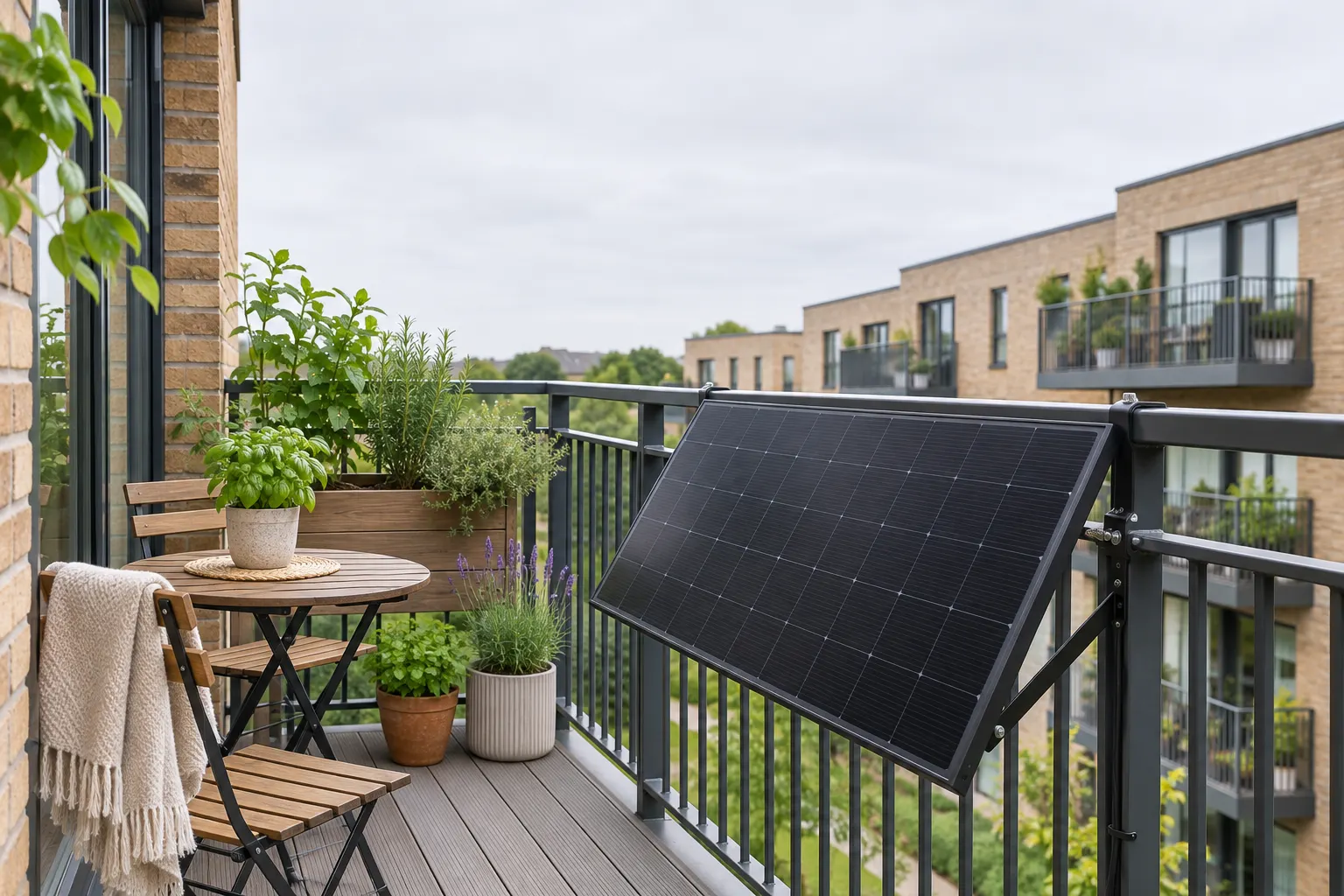
Balcony solar panels are plug-in solar on a balcony: one or two panels, a microinverter and a standard three-pin plug. It has been legal in England, Wales and Scotland since 27 August 2026. SI 2026/848 reg. 1 The electrical rules are the same as for any other plug-in kit, set out in our plug-in solar guide. This page covers what is different on a balcony: whether it is worth it, whether it fits and where you cannot mount it. Every legal point shows the date we checked it.
The Short Version
- Balcony solar is legal in Great Britain Legal
- Timber balconies and some cladding types Not allowed
- In a flat, ask the landlord or freeholder before you buy
- 800 W AC at most, one device per home
Are Balcony Solar Panels Worth It?
It depends on the light your balcony gets and on who is home in the daytime. A balcony kit does one job: it covers the electricity your flat is already using while the sun shines, such as a fridge, router and standby loads. Anything it makes beyond that goes out to the grid unpaid.
What DESNZ Says It Can Save
On 26 August 2026 DESNZ said households could save up to £110 a year with plug-in solar, and that a kit could provide up to 20% of an average home’s electricity use. DESNZ news, 26 Aug 2026 Read both as ceilings. They describe a good case. A balcony is often a harder case than a garden, because walls, neighbouring buildings and the balcony above all cast shade.
Nobody pays you for the surplus by default. The Smart Export Guarantee needs an MCS-certified installation, and we found no route for a plug-in kit to use it. So the value of a balcony kit is the power you use yourself, not what you export.
Orientation and Shade
Two things decide most of the result: which way the balcony faces, and how long it is in direct sun.
- South-facing balconies get the most hours of strong light, which is why they are the usual first choice.
- East- and west-facing balconies can still work well, especially if you are home in the morning or evening when the sun reaches them.
- North-facing balconies make little. For most flats they are not worth fitting.
- Shade matters more than people expect. A balcony above yours, a deep reveal or a tree can cut the output sharply.
The best test is a day of watching. Note when direct sun actually lands on the spot where the panel would sit. For a figure based on your own postcode and tariff, use the plug-in solar calculator rather than a rule of thumb. We do not print a payback number here, because any single number would be wrong for most flats.
Will It Fit My Balcony?
Check three things before you look at any product: the space, the way you will fix it, and whether the balcony can safely carry it. Measure the panel size in the listing against your railing length, floor area or wall space, and leave room to get past it.
- 1
Panels
Up to 2,000 W of DC
- 2
Microinverter
Caps output at 800 W AC
- 3
Three-pin plug
BS 1363, no adaptor
- 4
Your home
Appliances use the power first
Railing Mounts
A rail mount hangs the panel on the outside of the balcony railing, often tilted towards the sun. It uses no floor space and keeps the panel clear of furniture. The catch is the railing itself: it has to be solid, not a decorative rail, and not timber. The panel must be fixed so it stays put in wind and cannot work loose. The product specification requires mounting that is reversible and not permanent, so clamps and brackets that you can take off without damage are what you want. DESNZ interim product specification v2, §8.3.2, 2026
If the panel sticks out past the building line, the planning limits in the next section can apply.
Floor or Wall Mounts
A floor stand sits on the balcony and can be angled and moved through the year. It takes up room you may use for chairs or plants, and it needs to be held down so wind cannot tip it. A wall mount fixes the panel flat against the balcony wall. It saves floor space, but you are drilling into the building, and in a flat that is usually the freeholder’s decision. Choose a fixing that is removable and that you can reinstate when you leave.
Whichever you choose, the cable has to reach a fixed wall socket. The rules say never use an extension lead, multi-way adaptor, RCD adaptor or travel adaptor. Ofgem decision DCRP/MP/26/02, 2026 If the nearest socket is indoors, run the cable through a gap you already have, such as the door seal, and do not cut into the frame. If you need a new outdoor or balcony-side socket, that is electrician’s work.
Weight and Wind
A balcony is more exposed than a garden, and a panel is a large flat surface that catches wind. Neither the regulations nor the product specification give a load figure that we can quote for balconies, so we do not invent one. What to do instead: read the weight and wind rating in the manufacturer’s instructions, use the fixings supplied, and ask the freeholder or managing agent if you are unsure what the balcony can carry. A panel that could fall onto a pavement or a neighbour’s balcony is a risk to others, not just to you.
Where You Can’t Put Balcony Solar
Some places are ruled out by the product specification. It excludes ACM, MCM, HPL and timber cladding systems, timber balconies, and any building undergoing external wall remediation. DESNZ interim product specification v2, §8.3.2, 2026 If you do not know what your building is clad in, ask the managing agent before you buy.
In England, planning permission is not normally needed. SI 2026/896 made installation permitted development from 27 August 2026, as long as the panels stick out no more than 0.2 m from a wall facing a highway and 0.4 m from other walls. SI 2026/896 That order also rules out a wall, balcony or fence made of timber, and has exceptions for listed buildings, scheduled monuments and conservation areas where the wall faces the road. SI 2026/896 A railing-mounted panel can easily stick out more than 0.2 m, so measure it against the wall it faces.
That order amends England’s rules only. For Scotland and Wales we could not confirm an equivalent planning rule, so check with your local planning authority first. For the full legal picture, see Is plug-in solar legal in the UK?
Flats: Who to Ask First
In a flat, the building is not only yours. In England, the planning change applies to blocks of flats as well as houses, but it does not replace the freeholder or managing agent, who still control the structure and shared parts. SI 2026/896 A balcony is often part of the building’s structure or the freeholder’s retained land, so assume you need to ask.
No law gives a tenant a right to install plug-in solar. The product specification makes the manufacturer warn users that they are “responsible for obtaining any necessary permissions from the property owner, landlord, freeholder, managing agent or relevant authority prior to installation”. DESNZ interim product specification v2, 2026 DESNZ adds that decisions on requests are “a matter for landlords, freeholders or councils”. DESNZ news, 26 Aug 2026
A good request is short and specific:
- Say which kit, its size, and where on the balcony it will go.
- Say how it is fixed and that it is removable.
- Offer to remove it and make good when you leave.
- Say you will register the device on myplugin.solar before you use it, and tell your insurer.
Insurance is part of the conversation. The product specification requires the manual to tell you that you are responsible for checking the effect on your own insurance and on the building’s insurance. DESNZ interim product specification v2, §8.3.1, 2026 No rule requires a specific policy. Tell your contents insurer, and ask the freeholder whether the building policy needs to know.
Our renters guide walks through the approach, and the landlord and insurance guide covers the building policy.
Balcony Solar With a Battery
A plug-in solar device with a battery built in is still not permitted. The definition of a plug-in kit in the regulations excludes batteries, apart from control and auxiliary functions. SI 2026/848 reg. 2(3)(e) That rules out the all-in-one balcony units that bundle storage into the same box. A separate battery is a different product with its own rules, covered in our plug-in solar battery guide. Do not assume a seller’s “balcony power station” is allowed because it plugs in.
Choosing a Balcony Solar Kit
Three checks cover most of it:
- 800 W AC at most, no battery inside. The inverter sets the limit, so compare the inverter rating first.
- Complies with the interim product specification v2, with a standard BS 1363 plug and no adaptor in the box. Look for a plain statement of compliance on the box or listing.
- A mount that suits your balcony. A rail clamp, a floor stand and a wall bracket are different products. Buy the one that matches how yours is built.
You also register the device on myplugin.solar before you use it, with your name, your postcode and the make and model. Electricity North West, plug-in solar, 2026 There is no 28-day grace period: the network operator must be advised before, or at the time of, commissioning. ESQCR 2002 reg. 22(2)(c) Removal must be notified too, and you can install the kit yourself. Ofgem decision DCRP/MP/26/02, 2026 Only one device is allowed per home.
We do not rank kits on this page. For what each brand sells and the date we checked it, see best plug-in solar kits.
Sources
Each one opened and checked on 10 November 2026.
- SI 2026/848, the Plugs and Sockets etc. (Safety) and ESQCR (Amendment) Regulations 2026
- SI 2026/896, permitted development for plug-in solar (England)
- DESNZ, Plug-in Solar Device Interim Product Specification v2 (16 July 2026)
- DESNZ news, 26 August 2026: plug-in solar panels come to market
- Electricity North West, plug-in solar (register on myplugin.solar)
- ESQCR 2002, regulation 22 (as amended by SI 2026/848)
- Ofgem, decision on DCRP/MP/26/02 (G98 for plug-in microgeneration)
Questions people ask
Are balcony solar panels worth it?
For many flats, yes, if the balcony gets real sun and someone uses electricity in the daytime. DESNZ says plug-in solar could save up to £110 a year, which is a ceiling rather than an average. A shaded, north-facing balcony will save far less, so check the light first.
Do balcony solar panels work?
Yes. The panels feed a microinverter, which sends alternating current into your home through a normal plug, and your appliances use it first. They work best in direct sun and still make some power on bright, overcast days. They do not run a whole flat and do not store power.
Is it possible to install a solar panel in a balcony?
Yes, in Great Britain, if the balcony is suitable and you have any permission your lease needs. The mounting must be reversible and the panel secure in wind. It is not allowed on a timber balcony. Flat owners and tenants usually need the freeholder or landlord to agree first.
How expensive is balcony solar?
Prices change quickly in a new market, so we do not print one here. Our kit comparison shows what each brand sells and the date we read it. Compare the inverter rating and what is in the box, not just the headline price, and work out your own return with the calculator.
Can I put balcony solar on a rented flat?
Only with permission. No law gives tenants a right to install it, and DESNZ says decisions are a matter for landlords, freeholders or councils. Ask in writing, describe the kit, show it is removable and offer to take it down when you leave. A freeholder may also need to agree.